Muay Thai is known as “the art of eight limbs” because it uses fists, elbows, knees and shins. The fundamentals below form the foundation for everything that follows. Treat them as an introduction: techniques are best learned with a coach watching, and elbows and knees are always practised on pads, with control.
The stance
Everything starts from a balanced stance. For an orthodox (right-handed) stance:
- Left foot forward, right foot back
- Weight spread evenly across both feet
- Hands up, protecting your face
- Chin tucked, eyes on your partner
- Body slightly angled
Stay relaxed but ready, keep your guard high, and stay balanced enough to move in any direction. Left-handers usually stand the other way round, in southpaw.
Punches
The jab
Your most-used strike, for measuring distance and setting up combinations.
- Extend your lead hand straight out
- Turn your fist over as the arm extends
- Keep your rear hand protecting your chin
- Step in with your lead foot when you need to cover distance
The cross
The power punch from your rear hand, usually thrown after the jab.
- Drive your rear hand straight forward
- Rotate your hips and shoulders
- Push off your back foot
- Keep your lead hand protecting your face
Kicks
The roundhouse kick
The signature technique of Muay Thai, aimed at the legs, body or head.
- Pivot on the ball of your supporting foot
- Lift your knee and turn your hips through
- Swing the leg through the target
- Strike with your shin, not your foot
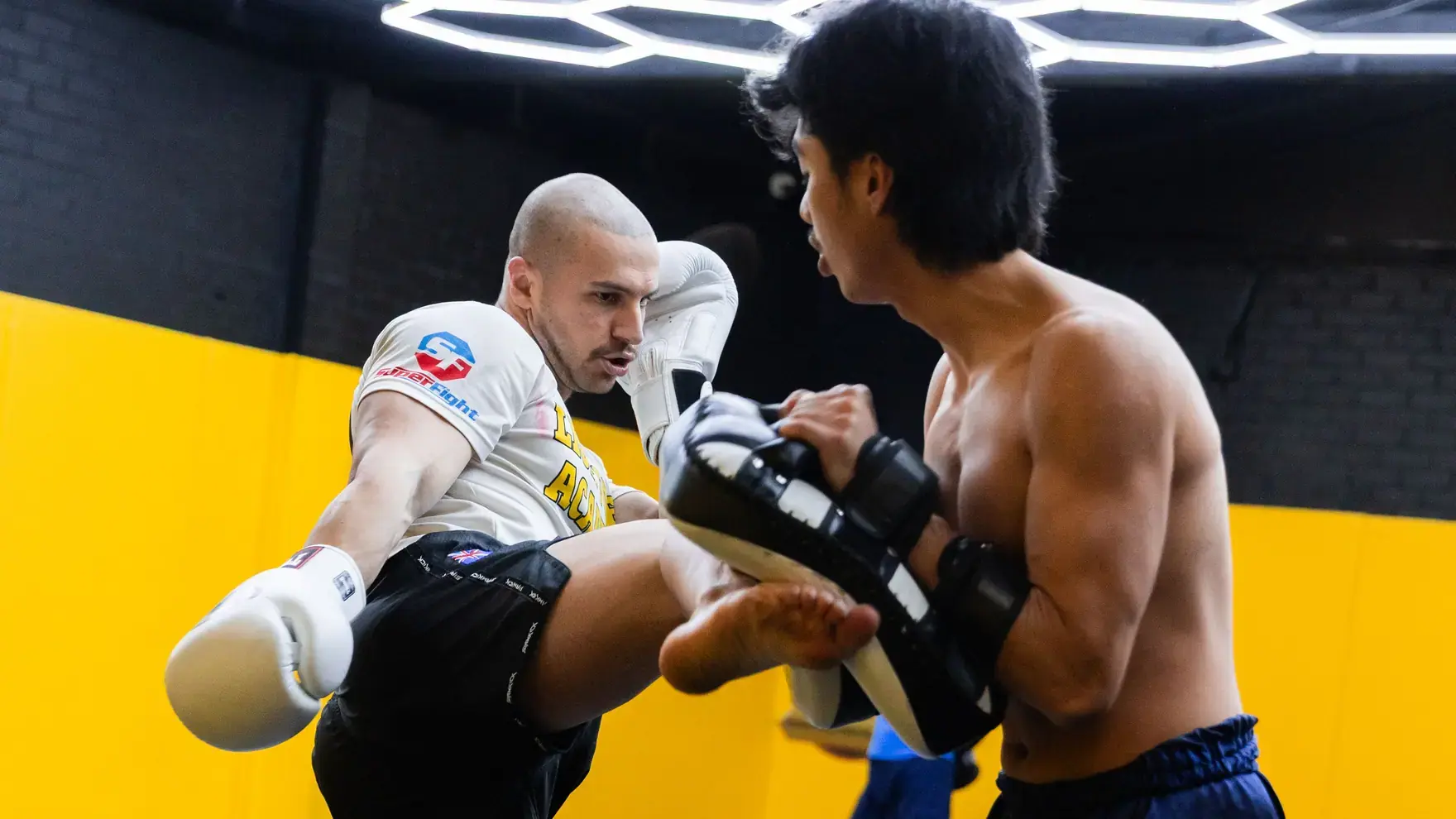
The teep (push kick)
Used to control distance and push a partner off balance.
- Lift your knee toward your chest
- Extend your leg straight forward
- Push with the ball of your foot
- Keep your hands up
Knees
The straight knee
A close-range strike, often thrown from the clinch.
- Control your partner’s head or shoulders — on pads, your partner holds the target
- Drive your hips forward and your knee up
- Stay tall and balanced on your supporting leg
Elbows
The horizontal elbow
A short-range strike for when you’re too close to punch.
- Raise your elbow to shoulder height
- Turn your hips and shoulders to drive it across
- Keep your other hand up to protect your face
Defence
The long guard
Extend your lead arm to frame against a partner while your rear hand protects your chin. It helps you manage distance and set up counters.
Checking kicks
Lift your shin to meet an incoming low kick, with your knee turned slightly out, so the kick lands on your shin. Then return to stance and counter.
Two beginner combinations
- Jab – cross – low kick: the jab sets up the cross, and the low kick finishes on your partner’s lead leg
- Teep – cross – hook: the teep creates distance, the cross meets your partner as they step back in, and the hook finishes as they circle
Training tips
- Form before power — get the technique right, then add speed and power
- Drill slowly at first to build good habits
- Shadow box regularly, at home or before class
- Use a mirror to check your stance and guard
- Work the heavy bag to feel power and follow-through
Common beginner mistakes
- Dropping your hands when you strike
- Not pivoting on your supporting foot when you kick
- Kicking with the foot instead of the shin
- Losing balance after a technique
- Holding your breath — breathe out sharply as you strike
An example first two months
Every coach sets their own progression, but a typical path looks something like this:
- Weeks 1–2: stance, movement, jab, cross, teep and shadow boxing
- Weeks 3–4: roundhouse kicks (low and mid), kick combinations and basic defence
- Weeks 5–8: longer combinations, more pad work and basic clinch work
Learning Muay Thai at Marrickville Martial Arts Club
Muay Thai classes at MMAC are led by coaches including Bastian Ayala, who has trained Muay Thai for more than a decade, including multiple trips to Thailand. Most of each class is technique and partner pad work, and both the morning and evening adult sessions take beginners.
Your first class is free: one trial class. See the Muay Thai program for what a first class involves and what to bring.